Evaluating team performance
SoccerSTATS.com - updated on: 28 Mar 2025
In league competitions, team performance is often evaluated using well-known indicators like Total Points, Points per Game, or Winning Percentage. To provide more comprehensive context when evaluating team results, the Points Performance Index considers Points Per Game in light of an additional factor: the Points Per Game of played opponents.
"It all evens out at the end of the season." We've all heard this, whether it's debating our team's bad luck with lost points, suspensions, or referee decisions, or acknowledging that other teams have had an easier schedule.
By the season's end, when every team has played the same number of matches against all opponents, both strong and weak, it's clear which teams had a successful campaign.
However, halfway through a league, while team rankings, points, and points per game offer useful insights into performance, these metrics only reflect performance within a specific context.
Overrated or Underrated?
Imagine your team is just one point behind a direct competitor, with a home game against a lower-ranked team still to play. Are you on track? Assuming a win in that game to catch up, you'd likely think so. It's a shame about those two points dropped last week against a supposedly easy opponent, though.
The league table might tell you a comforting story. And with that game in hand, if you only looked at Points Per Game instead of total points, your team might even rank above its direct competitors.
Yet, to truly understand your team's performance compared to its rivals, you need to examine where and against which opponents your team earned its points, and the same applies to your competitors.
Evaluating the Opposition
To assess the opposition's strength, we use the same metric used in the Run-in analysis table: an average value that considers the home Points Per Game (PPG) of all opponents faced away, and the away PPG of all opponents played at home. The resulting value is labeled "Opponents PPG" in the Relative Performance table.
Calculating the Points Performance Index
The PPI calculation aims to provide a rating that gives more weight to a team's more significant results.
For instance, if a team's last two matches were (1) a home win against a low-ranked team and (2) an away win at the league leaders', both results would be valued identically in the league table and Points Per Game calculations. However, the latter is clearly more meaningful in terms of performance.
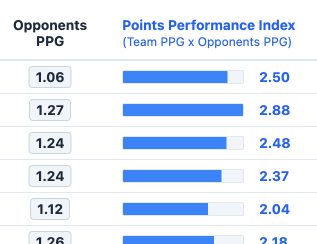
Each result a team achieves carries its own "weight," represented by the opponent's PPG. The combined strength of all opponents played by a team is represented by the Opponents PPG value in the table.
To calculate the Points Performance Index, we multiply the team's Points Per Game by their Opponents PPG value.
Calculating Projected Points
The Projected Points table displays a simulated points projection for each team, based on the team's Points Per Game (PPG), the PPG of opponents already played, and the PPG of future opponents.
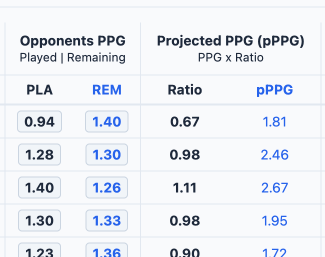
For each team, the PPG of played opponents is compared to the PPG of future opponents, resulting in a ratio.
If the played opponents' PPG is higher than the future opponents' PPG, the ratio will be greater than 1. If the ratio is below 1, it means the future opponents' PPG is higher than the played opponents' PPG.
This ratio is then applied to the team's existing PPG to create a 'Projected PPG' for the team. This 'Projected PPG' is then multiplied by the number of remaining games, and the result is called 'Projected Points'.
Further details on how Projected Points are calculated are provided in the description below the Projected Points table, for example, on the Projected Points page for Serie A.